A few spots are still available on our 10-day cruise out of Oban that departs on September 11. For details see the Hebridean Adventures website:
https://www.hebrideanadventures.co.uk/products/adventures-in-search-of-the-past-cruise


A few spots are still available on our 10-day cruise out of Oban that departs on September 11. For details see the Hebridean Adventures website:
https://www.hebrideanadventures.co.uk/products/adventures-in-search-of-the-past-cruise
I've only had the pleasure of making the sands sing on three Scottish beaches: Camas Sgiotaig of Eigg (first photo), Traign Bhàn of Islay (second photo), and Camas an Lighe near Kentra Bay (third and fourth photos). Be careful if you walk across Camas an Lighe, as you may stumble upon unexploded munitions.
 |
 |


Curious about what makes the sands sing, I found sources dating from 1891 to 1973. The first was an article in an 1891 issue of Nature, written by Cecil Carus-Wilson. You can find it at this link:
https://archive.org/details/naturelond44londuoft/page/322/mode/2up
In the article, the author states that the music from sand was simply the result of the rubbing together of the surfaces of millions of perfectly clean grains of quartz, free from angularities, roughness, or adherent matter, in the form of clinging fragments investing the grains, and that these microlithic emissions of sound, though individually inaudible, might in combination produce a note sufficiently powerful to be sensible to us.
Another description of singing sands dates to 1923 and can be found on pages 261-340 of the book Tales of Travel by CN Curzon. Pages 261-324 describe sands around the world that sing due to settling and/or wind action. Pages 324 and on describe sands that sing when walked on, beginning with the famous sands of Eigg. You can find the full text at this link:
https://babel.hathitrust.org/cgi/pt?id=njp.32101019098233&seq=322
The most informative source I came across was an article entitled Whistling Sand Beaches in the British Isles, written by K. Ridgway and JB Scotton. It appeared in Sedimentology: The Journal of the International Association of Sedimentologists, Volume 20, p.263-279 (1973). The link to it is:
https://www.researchgate.net/publication/229933615_Whistling_sand_beaches_in_the_British_Isles
Be aware that you have to pay to access that article. I am basically cheap, so instead of paying $15 for online access, I spent a whole dollar in bus fare and went to read a copy in the University of Washington Library. It was in a section of the library I'd not been to before, and to my surprise, I discovered a massive row of stacks filled with hundreds of journals and reports on Sedimentology—heavy reading, indeed.
The article described various experiments used to understand why the sands sing, which confirmed the theory stated in the issue of Nature quoted above. It also states that musical beaches are always near Bedload Partings (BLP) on the continental shelf. You can read about BLPs at the following link:
https://onlinelibrary.wiley.com/doi/abs/10.1002/9781444304138.ch1
Also included in the 1973 article was a list of the 33 singing sand beaches in the UK and Ireland. (See the map at the end of the post). If making the sands sing intrigues, here is a list of the musical beaches in Scotland:
Rackwick Bay, Hoy: ND 2063 9844; Dunnet Head; Cruden Bay: NK 0853 3506; Montrose Bay: NO 7351 6085; Lunan Bay: NO 6923 5113; Tyninghame Beach: NT 6268 8201; Broadsea Bay: NW 9712 6010; Ardneil Bay: NS 1869 4830; Traigh Bhàn, Islay: NR 3461 4409; Ardnish: NM 7001 8065; Roshven: NM 7044 7882 or NM 7099 7920; Camas an Lighe, Ardnamurchan: NM 6128 6903; Camus Sgiotaig, Eigg: NM 4710 8996; Guinaird Bay: NG 9509 9026; Clashnessie Bay: NC 0577 3106
As mentioned above, the only beaches in the list I've had the pleasure of making sing are those of Eigg, Camus an Lighe, and Traigh Bhàn. A short recording of the Blue Danube Waltz played on the Eigg Sands can be found in this post from 2013:
https://marccalhoun.blogspot.com/2013/04/the-sands-sing.html
There is one singing beach in particular on my list to visit, and that is the one at Ardnish. The reason is because of the stunning four-volume Ardnish series written by Angus MacDonald. If you've read the books, you'll understand why I want to walk out to the old settlements around Peanmeanach. Then, after seeing the ruins, I'd detour a mile west to make the sands sing. Directions to Peanmeanach are on this Walk Highlands page, which oddly makes no mention of the singing sands:
https://www.walkhighlands.co.uk/fortwilliam/peanmeanach.shtml.

In May I was fortunate to go on a boat trip organized by John Humphries of the Gatliff Trust. I was even more fortunate in that it departed from the old jetty at Rhenigidale; possibly the first time in decades that a large group has used the jetty.

As we waited for the boat to arrive, Widget came by. Widget's main home is Taigh a' Phuist, the Postman's House on the coast of Loch Seaforth, a half mile north of Rhenigidale. Widget, the bog-hopping kitty, can often be seen wandering the path between Rhenigidale and Taigh a' Phuist.


Under sunny skies, we motored east to transit Struth nam Fir Ghorma, the stream of the Blue Men: storm kelpies known to devour anyone unlucky enough to fall into the water. If we survived the kelpies, we were going to visit Bhalamas and the Shiants later in the day, but our first stop was Mul Thàgaraidh. In terms of land access, Mul Thàgaraidh may be the most remote place on Lewis. It lies at the base of a vast bowl of hills, 850-foot-high Fiar-Chreag to the north and 400-foot-high Creag Mhor to the south.


The crystal-clear waters of Abhainn Mul Thàgaraidh cleave between the hills surrounding Mul Thàgaraidh. In its half-mile journey from Loch Doimhne (Deep Loch) to the sea, the stream drops over 300 feet, then snakes its way past the house before forcing its way through the large stones of the beach.


In the 1860s the house was the home of the shepherd Norman MacDonald. He was here until Pairc became a deer forest in the 1880s. Just past the front door a narrow stairway led to the upper floor. It's a guess, but from the appearance of the rusting bedsteads, rotting mattresses and chairs, the house looks like it has not been occupied for decades.


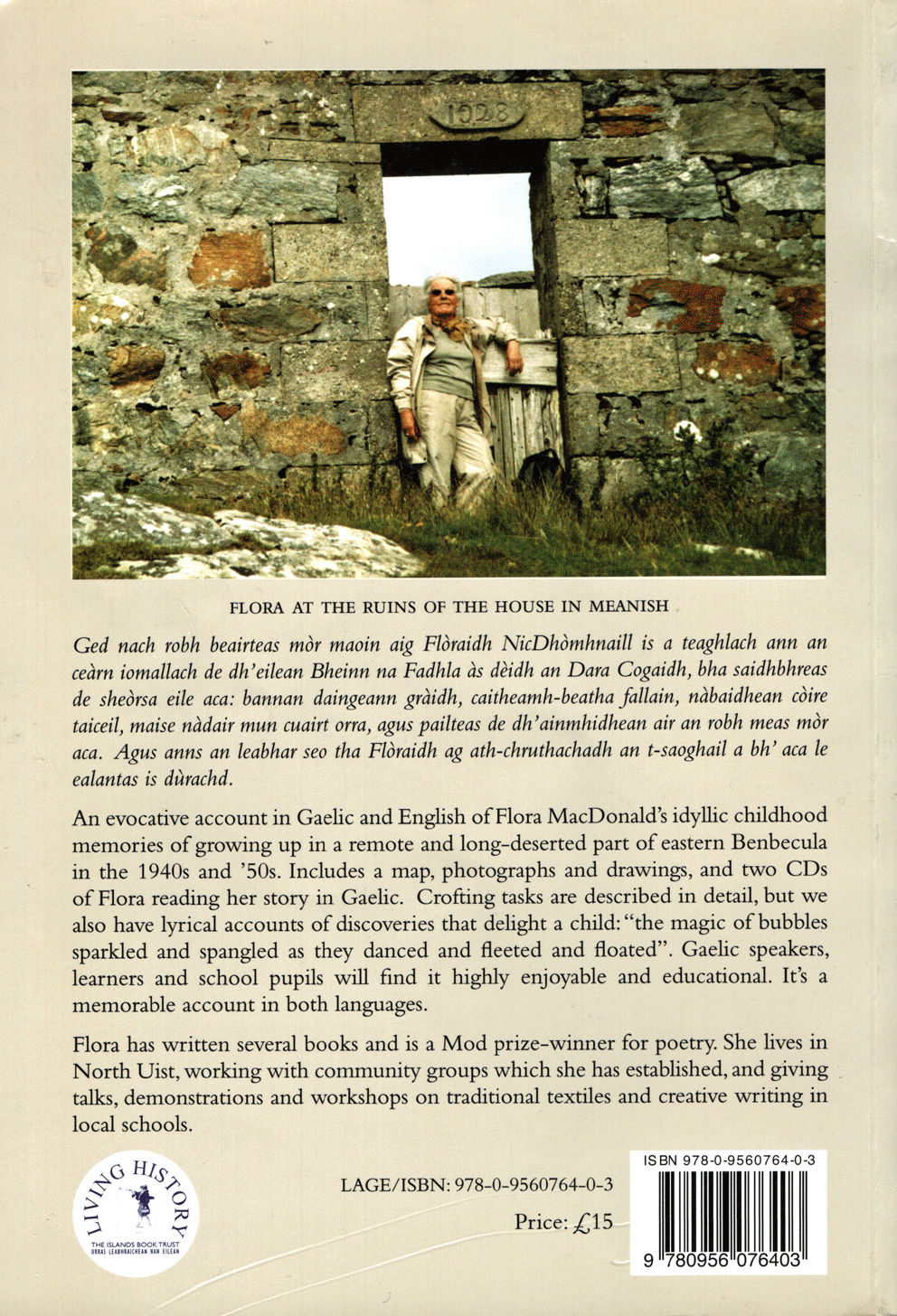
Last month I had the privilege of a guided walk with Alasdair MacEachen to two of the abandoned settlements of Nunton Hill. Nunton Hill lies in the centre of Benbecula, between the highway and the sea, and I wanted to visit it due to two books I'd read. The first was Coco is Crubagan: A Hebridean Childhood (published by the Islands Book Trust in 2009). The book tells the childhood story of Flora MacDonald, who grew up in the Nunton Hill croft known as Meanais in the 1940s and 50s. I read it in depth multiple times as my Gaelic class spent many lessons reading and translating the text in 2010.




It had been a memorable day out. And I'd like to thank Alasdair for showing me the area. Be sure to read Coco is Crubagan, and then do this walk yourself. Nunton Hill was abandoned because a road was never provided, but while it was alive it had been a remarkable place, made immortal by Flora MacDonald's book.
Note that Alasdair MacEachen will be guiding walks through this area on June 15 and June 22. See this link for more information: https://islandsbooktrust.org/pages/events-1
I've just returned from two weeks in the Western Isles to attend the book-launch events for Thirty Years of Adventures in Search of the Past: The Outer Hebrides. We had a good turnout at the Harris Hotel on May 14 and the Uig Community Centre on May 21 - some photos below.
I also managed to do several hikes, as the weather was stunning. The hikes were to the beehive cell of Sron Smearasmal, the Calbost shieling of the one night, the rocky summit of Cracabhal, and the abandoned settlement of Meanish on Benbecula. (Meanish was the childhood home of Flora MacDonald, who wrote about it in Coco is Crubagan.) I was also fortunate to join the folks at the Rhenigidale Hostel for a boat trip to Mulhargarry and Valamus on the remote shores of Pairc. I will be posting on those new adventures In the coming days.
Adventures in Search of the Past: The Outer Hebrides be purchased from the Islands Book Trust at the following link:
https://islandsbooktrust.org/products/thirty-years-of-adventure-in-search-of-the-past


As you can see in the photo, it's a beautiful day here in Seattle. It was on this spot where the first settlers arrived in 1851. I hope the Hebridean weather is as kind over the next few weeks, as I will be coming over to launch my book, Thirty Years of Adventures in Search of the Past: The Outer Hebrides. The first launch event will be at the Harris Hotel on May 14 (5pm). The second will be at the Uig Community Centre on May 21 (5:30pm). I hope to see you there!

I am pleased to announce that the Islands Book Trust is now offering an Advance Order option for my new book - Thirty Years of Adventures in Search of the Past: The Outer Hebrides. Advance orders will be filled after the book launch in May.
https://islandsbooktrust.org/products/thirty-years-of-adventure-in-search-of-the-past


