Showing posts sorted by relevance for query Brian harper. Sort by date Show all posts

Sunday, September 1, 2013

Lighthouse Cruise 3 - Scarp

After our visit to the Monachs we headed north to Scarp. There is no lighthouse on the island, but it would make a good starting point to try for the Flannan Isles the next day.

As it turned out, the visit to Scarp was one of the major highlights of the cruise. I had visited the island a few times before. On the last occasion, in 2010, I met two Scarp residents, Brian and Sheila Harper. Brain is a subscriber to Scottish Islands Explorer, so in a sense he knew me, and I was invited in for tea. Since then I've met Brian and Sheila twice, including one occasion in Huisinish that was the subject of the August 6 post.

So when we visited Scarp on August 9, only a few days after I'd last seen Brian and Sheila I was delighted to come across them on their way to the island. I had spent the day ashore, climbing to the summit of Sron Romul, the highest point of Scarp. After descending to the village I knocked on Brian's door, but no one was home, so I left a note saying we'd be anchored here for the night, and to visit us when they returned.

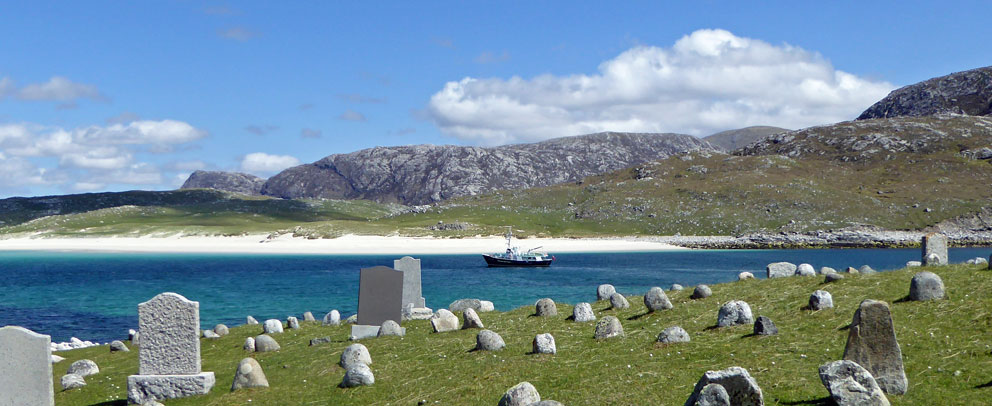
I then had a chance to see the restored church. When I first visited Scarp in 2004 (see Book 2, chapter 30) I had wandered through the ruined church after chasing several sheep out. The first photo is from that visit. The second shows the chapel as it looks now. Beautiful.

Scarp church  - 2004
Scarp church  - 2013
After seeing the church we returned to the boat for the night. As we were doing this we saw Brian and Sheila returning to Scarp from Huisinish. Their boat, from a distance looked odd. And as they neared us the reason was clear. They were ferrying a mattress over to Scarp.

Mattress delivery - Scarp
We had an enjoyable dinner on Halmar Bjorge with Brian and Shiela. And afterwards watched them motor back to Scarp in the twilight.  The next day we set our sights on the Flannan Isles.

Tuesday, August 6, 2013

A Man of Scarp

I drove down to Husinish yesterday. It is at the end of the long and windy road heading west from Tarbert (Harris). I drove there to take a look at Scarp, and pay a visit to a man I met on Scarp a few years ago. The man is Brian Harper, and he is an amazing fellow. He has a house on Scarp, and is also renovating one in Husinish. The photos below show him motoring in on his RIB after taking two men, a dog, supplies, and a large propane tank over to Scarp. His RIB has built in wheels on the back so he can haul it up the jetty by himself. 

Brian nearly back from Scarp

Brian pulls the RIB onto Husinish Jetty

Tuesday, December 31, 2019

The Scarp Hostel

One of my favourite Hebridean islands is Scarp. I well remember several visits to Harris in the 1990s, standing at the slipway at Hushinish looking over to Scarp. I had no idea then how to get there, and neither did anyone I asked. Over a decade later, in the spring of 2004, I finally set foot on the island during a cruise on Hjalmar Bjorge. Since then I have been fortunate to have visited Scarp a half dozen times. To date I've not had the chance to spend a night on the island, something I'd dearly like to do. 

But between 1965 and 1971 several hundred travellers managed to do just that. During those six years there was a Gatliff Trust hostel on Scarp, truly the most remote hostel in Britain, even more remote (in terms of accessibility) than the Trust's hostel at Renigidale. To date I have not been able to identify where the Scarp hostel was. I am guessing in the village near the shop and phone box, but that is pure speculation. Brian Harper, a spring/summer resident of Scarp for many years, has no idea where it was. And neither does John Humphries, who has been involved in the Gatliff Trust for a long time.

The only information I can find on the Scarp hostel are the reports on its status published in the Gatliff Trust's yearly reports (which you can find here.) Put together, these reports provide a bare-bones sketch of the hostel's six-year life. What follows are excerpts from those reports relating to Scarp between the years 1965 and 1972. Placed between each year's report are photos from a cross-island walk made over the top of Scarp in 2013: sights those visitors to the hostel would have seen, and remembered.

The 1965 Gatliffe Trust yearly report has this first mention of Scarp: There is good prospect of our having next summer the use of old thatched houses in the islands of Scarp and Berneray.


The 1966 report states: The Scarp hostel opens. 75 bednights recorded. Scarp is harder to get to than Renigidale as the mailboat only makes the crossing every other day, and the twice-weekly bus to Husinish does not run on those days. Those who went found it very well worthwhile; for Scarp is not only beautiful in a rugged way but probably the most 'apart' of all islands still inhabited in the Hebrides and gives a very special welcome to visitors.


The 1967 report states: 95 bednights recorded. Scarp is more difficult to reach, because the bus service is scanty, hitching not to be relied on and the sea crossing infrequent and sometimes difficult. But those who are prepared to sleep out for a night on the way, or in sufficient numbers to meet the expense of special transport or a boat, and have several days to spare, can find it an even more rewarding adventure. A boy of 17 wrote "No one is likely to forget the strange feeling of having suddenly been washed up on the shores of a Tristan da Cunha."  The hostel had last summer rather more use than we had ventured to hope. An American hosteller commented: "Most enjoyable stay anywhere made more so by the hospitality of the MacLennans and the people of Scarp."

The last entry in the 'house book' for 1976 is a suggestion to advertise the Scarp hostel more widely, and include it in the S.Y.R.A. handbook. Just following this comment, but in different handwriting, is: "No please don't. Let it be the wonderful surprise to others as it was to us."


The 1968 report states: 107 bednights recorded. The Maclennans have left Scarp and live at West Tarbert, but Norman Macinnes has taken charge of the hostel. He and others however are probably leaving before long, and it may be that the island must become a sheiling lived in only during the summer. 


The 1968 report states: 60 bednights recorded. Angus and Joan MacLennan have retired to the mainland, and, sad as it is to see old people leave their island homes, no doubt it's best they should go where life is easier. Norman McInnes, who took over, is still there and we are glad to hear he'll be for another summer at least. Fewer hostellers reach Scarp than Howmore or Rhenigidale, but those that do find it very rewarding. A visitor wrote "To stay in Scarp hostel is a great privilege; the house is a living page from the folk history of Scotland." It's strangely moving to find this written of the most primitive hostel in Britain. 

Scarp from all we hear will be lived-all-the-year-round-in for a little while yet, but as those who live there get older it may not be possible or indeed right that they should remain much longer. If not it may still be possible for some of them, and some of you who love the island, and such bodies as the Schools Hebridean Society to keep it lived in in summer, a live sheiling, including the hostel.


The 1970 report states: 146 bednights recorded. The news from Scarp was not so good. We heard in October that part of the roof had fallen in, and the house was no longer habitable. We were not clear which part, or whether it was due to Act of God (wind) or act of cow (grazing) - the hostel is believed to be the only inhabited house in Britain (except perhaps flats in the Barbican in the City of London) that has grazing grass on the roof. 

At Easter however Michael Gerrish and two friends went over with a lot of polythene, found it was only the barn end that had fallen in, probably by act of sheep, not cow, and made the hostel part weatherproof for at any rate another summer, though perhaps after that the walls will fall in or out. Whilst more people are leaving the island, one or two are likely to remain all the year round, at any rate for some years. We are considering whether we should try to get the use of some other building.


The 1971 report states: 139 bednights recorded. In the Autumn of 1969 we heard that one end of the building had fallen in and was really no longer suitable for use. However, Myke Gerrish and friends going over in the Spring found it was the byre end, and did considerable first-aid. This survived for a while and the hostel was just usable. But the wind damaged the first-aid and, more important, the roof over the other end, the dormitory, began to collapse. We reluctantly had to recognize that the building could not be kept habitable and must be abandoned. However for 6 years it had provided something unique in Britain.


The 1972 report states: Scarp, as we said in our last letter, had to be abandoned, and we were unable to find any replacement there; indeed, the island is no longer inhabited all the year round. 

* * *
The last year-round residents of Scarp left in 1971. Today it is only occupied for several months in the spring and summer. If you ever get a chance to visit Scarp, do it. It is a large island with some challenging terrain; an island that takes several visits to completely see, and those are the best kind.

Tuesday, June 20, 2017

Scarp Calling

After a calm night tied to the Leverburgh pier, we watched the three St Kilda day-boats head out at 8am. The island on our plate for that day is as interesting as St Kilda, and much less visited: the island of Scarp. After breakfast we headed up the Sound of Harris, out past Toe Head, and into the Atlantic. After two hours of steaming we circled the top of Scarp to motor into Cearstaigh Bay at its north end. It's a good spot for eagles, and we floated for a while searching, but none were seen.

Cearstaigh Bay
From there we headed down the east side to drop the hook off Scarp Village. The island looked as inviting as ever from the sea, and we were soon ashore.

Scarp Landing
Like St Kilda, Scarp has a line of old blackhouse dwellings, long abandoned, and we started our tour by wandering among them. In 1881 over 200 people called Scarp home, but by 1971 the population had dwindled to seven. The island’s moment of fame came in 1934, when Gerhard Zucker experimented with rocket powered mail delivery. After the fuse was lit, instead of shooting 1000 feet across to Harris, the rocket exploded, and the mail got a little charred. Zucker's rocket experiments were depicted in the 2004 film The Rocket Post, which was filmed on nearby Taransay,


Our next stop was to take a look at the crumbling remnants of the school. It's a sad sight, but next to it stands the beautifully redone church. When I first visited Scarp (2004), the church was also in a sad state; full of sheep, half its floorboard rotted, and there were missing doors and windows. But unlike the school, it was rescued several years ago.

Ruined school (left), restored church (right)
After exploring the village we headed to the top of Beinn fo Tuath. Even though mist topped the distant hills of Harris, the view over to the three large sea-lochs that cut into the west of Lewis is truly spectacular. A group photo was called for.

Atop Scarp - misty hills of Harris in the distance
From the top we descended to Loch a’ Mhuilinn (Mill Loch). It is a special spot, for lying in the stream that runs from the loch to the sea are a pair of Norse mills, their millstones still in place. It was here that Alan fired up his drone and got some footage flying over the mill loch and the interior of Scarp.

Loch a' Mhuilinn
Alan prepares the drone
Following the stream downhill we came to the mills, their grinding stones still in place. For more photos of Hebridean mills (including Scarp's) see this link.


Where the mill stream reaches the sea we came to Mol Mor. The Gaelic name means big pebbly beach, but it's locally known as Treasure Beach, for the occasional treasures that wash ashore. There was no sign of anything valuable, unless you treasure old fishing floats and plastic flotsam.

Looking for treasure...
An easy coastal walk took us back to the village, where there was time for a brief visit with Brian and Shiela Harper, who call Scarp home part of the year. Their resilience in making it to Scarp every year is impressive. Getting here, even in the summer, can often be a challenge. See the August 6, 2013 post for photos of Brian, single-handedly, landing his inflatable on a windy, and wavy, summer day.

It was getting late, and so we had to leave Scarp in our wake to steam five miles around the Ardveg Penninsula to look for an anchorage for the night in Loch Hamanavay. Hamanavay is the one of the most remote, and least visited places in the Western Isles. We were in the Hebridean Back of Beyond.

To be continued...

Tuesday, May 17, 2022

The Adventures of Hjalmar Bjorge - Season 5, Episode 2

The Continuing Adventures of Hjalmar Bjorge
Season 5 - Episode 2 - Isay to Scarp
Exploring the Isles of the West Cruise    April 18-May 2, 2022

After our exploration of Isay we steamed across the Minch under cloudy skies. After passing through the Sound of Harris, Charlie took us up past Taransay and into the Sound of Scarp. As we passed Huisinis, on the Harris side of the Sound, we could see the Stiomar cutting across the Harris slopes. It is a thrilling, steep path, that leads from Husinis over to historic Cravadale. (For a description of that walk see this link: Cravadale Walk). Most who take the path do not go to Cravadale, as a side trail halfway along branches off to Traigh Mheilein, one of the most stunning beaches in the Hebrides. 

When I'd hiked the path in 2013 I did not take the detour to the beach, as I was exhausted. Little did I know that we'd be visiting that glorious beach the following day, and in doing so encounter the most surprising thing I've ever seen on a remote island beach. In the following photo you can just barely see the Stiomar path halfway up the hillside.


We anchored for the night just off the Scarp settlement, which saw its last full-time residents in 1971. The following morning we were greeted with sunshine and mostly clear skies that would be with us for several days. 

After landing on Scarp I led the group through the blackhouse settlement of North Town, and then to the old shop, post office, and burial ground.  


We then hiked up to the old schoolhouse, which is still in the process of falling down. When I first visited Scarp, in 2004, the roof was intact. But instead of scholars, a large class of sheep was sheltering inside. A while back the owners put a bit of money into the structure, complete with flush toilets. But they did nothing to improve the roof. Needless to say, winter winds took the roof, and the building won't last much longer.


Before leaving Scarp we stopped in to see Brian and Shiela Harper, who have been spending their springs and summers on the island for many years. They are a lovely couple, and it was a delight to see them again over a cup of tea. (See this link for more on Scarp and the Harpers: Scarp Posts.)


Brian then told me something surprising: a wedding was going to happen that afternoon on Traigh Mheilein beach, just opposite Scarp on Harris. So when Charlie offered to run us over to the beach for a couple of hours, some of the group decided to come along.

Magnificent does not come close to describing Traigh Mheilein: a mile-long stretch of blinding-white shell sand. What few visitors it does see, have to climb the Stiomar from Huisinis, a mile-long hike along that path that climbs 300 feet as it hugs the steep slopes of Huiseabhal Beag. (Most are not as fortunate as we were to be set ashore from a boat.) The following photo shows the view from the path looking down to Huisinis.


It was an entrancing walk along the beach to its north end, from where an easy hike over the dunes led to Loch na Cleabhaig. In the following photo the lone house of Cravadale can be seen on the far side of the loch.


From the high ground above the beach I had a birds-eye view over the Sound of Scarp, with Hjalmar Bjorge resting peacefully at anchor.


When I returned to the beach I had a vision: A lovely young woman in a flowing white dress slowly walking across the white sands, accompanied by a tall man in a kilt. (As it turned out, she'd injured her leg on the hike out.) From a discrete distance, I took a photo of the wedding party before Charlie came to return us to Hjalmar Bjorge. While he was ashore, Charlie was approached by someone from the wedding party, who asked if it would be possible to return the bride to Huisinis in the RIB, so that she would not have to make the strenuous return hike with a bad leg. Charlie was happy to oblige. Hjalmar Bjorge, a former rescue boat, had come to the rescue once again.


Back on the ship, we sat on the deck to watch the ceremony, which took a very long time; a drone flying around to take photos of the event: Charlie patiently waiting on the beach for over an hour.


All in all, it was one of the most unusual, and delightful, Hebridean days I've ever had: I'd seen old friends, showed off one of my favourite islands, and witnessed a beach wedding. We spent the night anchored in the sound, and in the morning set off for the Flannan Isles.

Three men alive on Flannan Isle,
Who thought on three men dead.

Thursday, July 21, 2016

Afoot on Scarp

On May 24 we got an early start from the Monachs to make the 40 mile trip north to Scarp. Unfortunately the wind was out of the north, which made the usual Scarp anchorage, on the north side of the sandbar between Scarp and Harris, unworkable. So we motored around the south of Scarp and turned left off the jetty at Huisinis to enter Caolas an Scarp (Kyles of Scarp). Passing Huisinis gave us a good view of the Stiomor, the steep path that leads up and over from Huisinis to Cravadale (see the December 31, 2013 post for a description of walking the Stiomor).

The Stiomor climbing the steep hillside to Cravadale
After dropping anchor in Caolas an Scarp we went ashore to explore the village. There used to be a Gatliffe Trust hostel here, but access to the island was (and still is) so very iffy, that it was only in business for four years (1966-1970). The island was mostly abandoned by 1971.

Scarp village
Hjalmar Bjorge anchored in Caolas an Scarp


We ended our tour of the village by taking a look at the sad remnants of the school, and on a brighter note, going inside the beautifully redone church.


Inside the school
Inside the redone church
I wanted to lead some of the guests up and over the hills to see the two Norse Mills on Allt a' Mhuilinn. But the first priority was to say hello to Brian and Sheila Harper, who live on Scarp for most of the spring and summer every year. I first met them six years ago, and no visit to Scarp is complete without stopping to have tea with this lovely couple.

After tea we set out to climb the hill pass between the two peaks of Beinn fo Tuath, and then on to the summit of the higher peak. As you can see in the photo below, on a sunny day the view west to Lochs Resort, Tealsavay, and Hamanavay is amazing.

The view to Loch Resort, Tealsavay, and Hamanavay
From the summit of Beinn fo Tuath a gentle descent was made west into the rocky interior of Scarp. I was leading Clare and Nigel to see the Norse Mills, but I led them astray at one point, and we had to backtrack a bit to find the stream that flows out of Loch a Mhuilinn (Mill Loch). Halfway between the loch and the sea we found the mills, their millstones still in place. For more photos of the Scarp mills see the March 16, 2013 post.

Mill
Next up was a walk down to Mol Mor. Its Gaelic name means big pebbly beach, but it's better known as Treasure Beach, for the occasional treasures that wash ashore. We found no treasure on our walk, just a trove of colorful plastic flotsam.

Mol Mor (AKA Treasure beach)
There was hardly a cloud in the sky as we made our way back to the vllage by walking around the south tip of the island. At one point we made a brief detour up the hillside to take a close look at Carn Choinnich Shaoir (Kenneth's Cairn). A rusting plaque on the cairn reads:

THIS CAIRN WAS BUILT BY
THE REV. DR. KENNETH MACLENNAN  BA. B.D. M.A. PhD
(COINNEACH SAOR) WHEN HE WAS A BOY IN SCARP
BORN IN TARBERT 21ST JUNE 1867
GRADUATE OF McGILL UNIVERSITY, TORONTO
AND WOOLSTER UNIVERSITY, OHIO
MINISTER OF THE PRESBYTERIAN CHURCH OF CANADA
THE UNITED FREE CHURCH OF SCOTLAND
AND THE CHURCH OF SCOTLAND
MISSIONARY IN HONAN, CHINA 1893-1897
DIED IN TORONTO 11 JUNE 1943
"CUIMHN IS IOMRADH MAITH"

Kenneth's Cairn
I am not sure what 'Cuimhn is Iomradh Maith" means: perhaps 'Remembrance and good account'. If anyone has a better translation please let me know.

We were soon back at the village, and after saying goodbye to Brian and Sheila we boarded the inflatable to return to Hjalmar Bjorge for the night. Unfortunately, the forecast ruled out making a dash out to the Flannans the following morning. It was a disappointment, but one I'm used to. Out of five attempts to get to the Flannans over the years, only one has been successful. On next year's guide-trip we'll make another try.

In the morning we set course to two of my favorite islands in the Sound of Harris: Pabbay and Boreray. My visits to those islands in the past were on shallow draught boats, so the question was whether we'd be able to find a decent anchorage for the 91-ton Hjalmar Bjorge in the shallow water near those islands. Fingers crossed, we set out to take a look.